Refrigeration in the Ice Cream Industry: Technology, Efficiency and Control to Preserve Quality
Ice cream sales in Spain are estimated to be growing at a rate of 13% in value terms and 8% in volume, according to an article published by ElEconomista.
In ice cream manufacturing, refrigeration plays an active role in the production process. Temperature, freezing rate, air circulation and thermal stability have a direct influence on texture, creaminess, melt resistance and shelf life.
For this reason, the refrigeration system must be designed taking the entire process into account, not just the cold rooms. The refrigeration plant must simultaneously cover mix cooling and ageing, freezing, rapid hardening, product storage and air conditioning of the work areas.
Refrigeration as a technological ingredient in ice cream
Ice cream is a complex structure made up of frozen water, a concentrated liquid phase, fat, proteins and incorporated air. During manufacture, the objective is not simply to lower the temperature, but to control how ice crystals form and how the emulsion is stabilised.
The industrial process normally includes mixing, pasteurisation, homogenisation, cooling, ageing, dynamic freezing, forming, hardening and storage. After pasteurisation, the mix must be cooled rapidly to the ageing temperature. As a technological guideline, it is kept below 5 °C for at least four hours, promoting the hydration of proteins and stabilisers and the partial crystallisation of the fat. Insufficient ageing can lead to difficulties in incorporating air, texture defects and faster melting.
Continuous freezing is at the heart of the process. In the freezer, the mix is cooled while being agitated and air is incorporated, forming a semi-fluid structure. Approximately half of the water may be frozen at the outlet, so the product still requires subsequent hardening.
Fast hardening: the key to a fine texture
Ice crystal size is one of the main indicators of quality. Fast freezing produces small crystals and a creamier mouthfeel, whereas slow heat removal promotes the formation of larger crystals and a coarser texture.
The hardening tunnel must provide very low temperatures, high air velocity and uniform air distribution over the entire product. In industrial processes, the air temperature may be around –40 °C. The aim is to quickly increase the frozen water fraction and reduce the time during which the ice cream remains within a critical temperature range. On certain production lines, hardening is considered complete when at least 80% of the water is frozen. 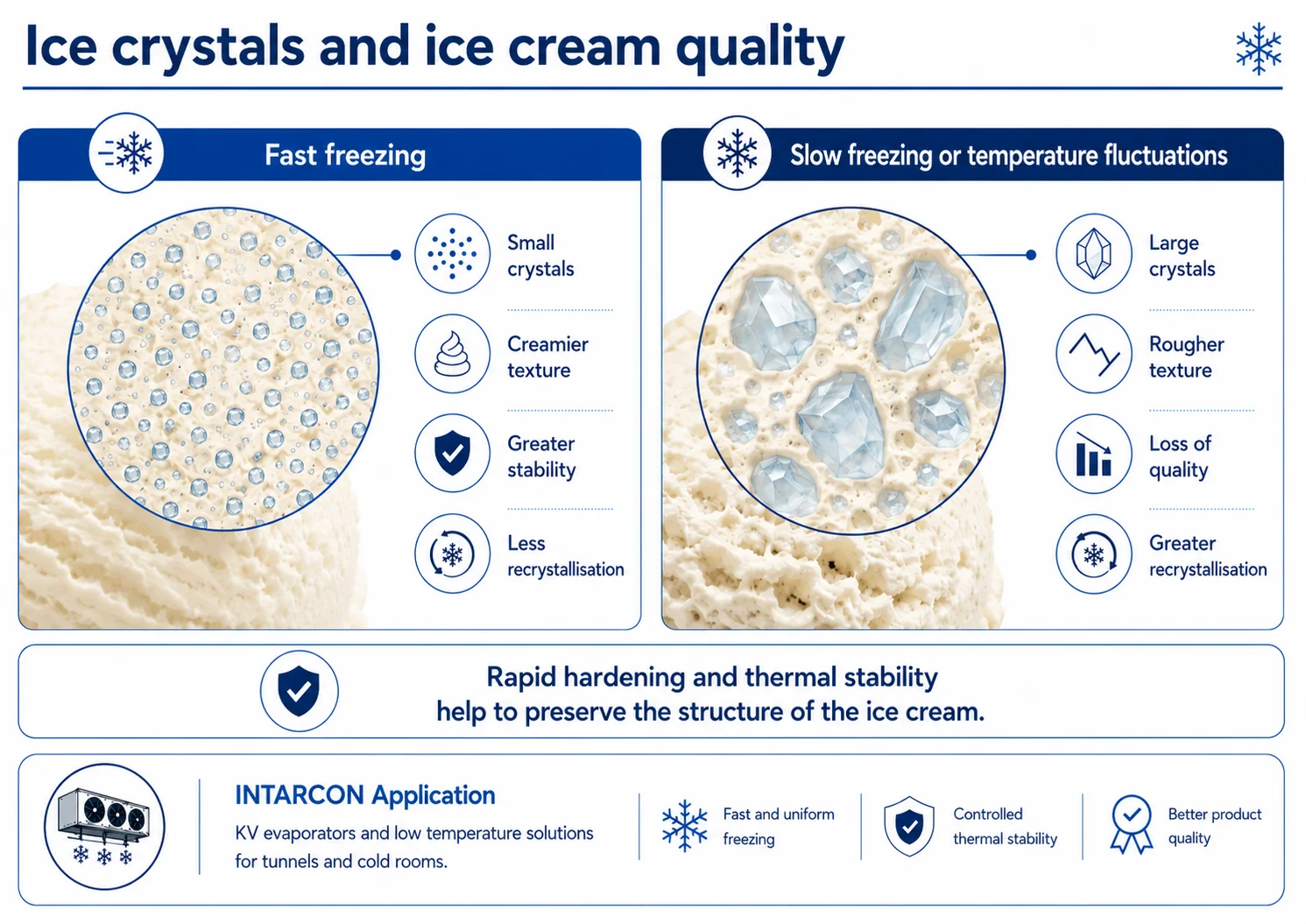
Installing a high cooling capacity is not enough. The design must prevent airflow short-circuiting, dead zones and temperature differences between trays, racks or product levels. Evaporator selection, air throw, available fan pressure and the defrost system are just as important as the rated cooling capacity.
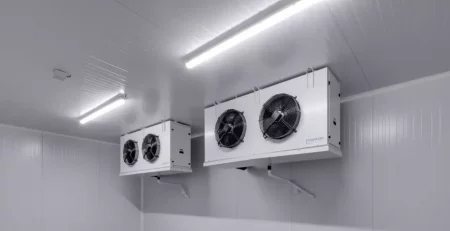
INTARCON’s KV series wall-mounted evaporator units are designed for freezing tunnels, with high-airflow fans and high available pressure, configurations adaptable to racks, and versions prepared for different refrigerants.
INTARCON refrigeration solutions for the ice cream industry
An ice cream factory has different refrigeration loads: preparation and ageing require positive temperatures, storage cold rooms require low temperatures, while freezers and tunnels require more demanding evaporating temperatures.
This diversity means that the refrigeration architecture must be carefully assessed, with options including glycol or brine systems, direct expansion, CO₂, low-charge ammonia or hybrid solutions. The configuration will depend on refrigeration capacity, load simultaneity, evaporating temperatures, climate, factory layout, process criticality and possibilities for future expansion.
Indirect systems with R290: flexibility and low refrigerant charge
In process applications, indirect systems allow the primary refrigerant to remain contained within a compact plant while cooling energy is distributed using glycol or brine. This solution makes it easier to distribute refrigeration to ageing tanks, heat exchangers, work areas and air coolers, reducing the amount of refrigerant circulating inside the factory.
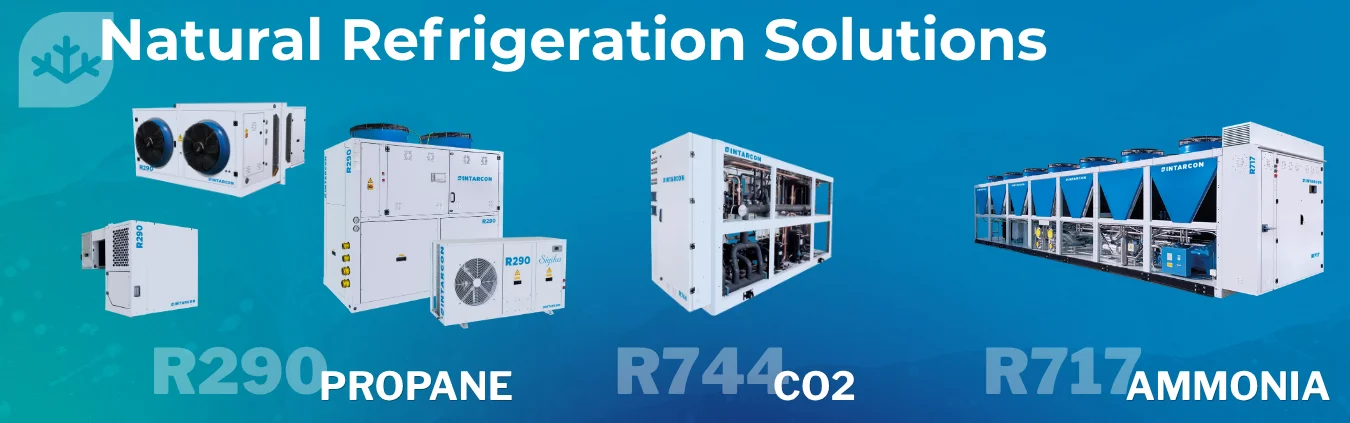
INTARCON’s intarCUBE R290 and intarWatt R290 plants are designed to produce chilled water, glycol or brine with a reduced propane charge. The Full INVERTER versions modulate compressor capacity and adapt refrigeration output to variable demand, which is particularly useful when shifts, batches and the number of production lines in operation change.
This modulation reduces starts and stops, improves supply temperature stability and can reduce energy consumption during part-load periods. Certain configurations also allow heat recovery to produce hot water for cleaning, auxiliary services or preheating.
CO₂ solutions for the ice cream industry
INTARCON offers various CO₂ (R744) solutions to meet the refrigeration requirements of an ice cream factory, from storage cold rooms to freezing tunnels:
- Transcritical CO₂ – ECO₂Watt: allows medium- and low-temperature services to be integrated into the same unit, with single or double suction configurations and a built-in gas cooler. It is a suitable solution for industrial installations where refrigeration production for cold rooms, process areas and freezing is to be centralised.
- Subcritical CO₂ R744/R290 – ECO₂Watt: particularly suitable for low-temperature applications, frozen-product cold rooms and freezing tunnels. The CO₂ operates in cascade with a high-temperature propane (R290) circuit, providing a solution based entirely on natural refrigerants.
- Subcritical CO₂ – ECO₂Rack: for projects requiring a more flexible configuration, with single or double suction and the option of condensing the CO₂ using water or glycol. This architecture makes it possible to integrate low- and very-low-temperature services, such as those required for freezing and deep-freezing processes.
These solutions allow the refrigeration architecture to be adapted to the specific requirements of each factory, using CO₂ both for product storage and for the most demanding freezing processes.
Low-charge ammonia for high refrigeration demands
In larger-capacity factories, ammonia remains a benchmark due to its thermodynamic properties. Today’s packaged solutions make it possible to reduce the refrigerant charge and confine the refrigerant to outdoor or technical areas. In this respect, INTARCON’s ammolite NH₃ chillers are designed for medium- and low-temperature industrial applications, with air condensation, variable-speed screw compressors and a reduced R717 charge. They can supply indirect glycol or brine circuits serving processes, cold rooms or ice cream hardening systems.
INTARCON Smart Services: supervision to anticipate deviations
INTARCON Smart Services allows the operation of the refrigeration system to be remotely monitored, analysing variables such as temperatures, pressures, superheat, compressor operation, valve opening, defrost cycles, energy consumption and alarms.
Based on this information, it is possible to identify deviations, performance losses or abnormal behaviour before they can affect the production process, while also facilitating diagnosis and maintenance operations.
The service uses the kiconex platform for the acquisition, logging and analysis of system data, but goes beyond simple monitoring: with INTARCON Smart Services, customers can benefit from specialised supervision and follow-up by INTARCON regarding the operation of their refrigeration equipment.
Ultimately, refrigeration system design should begin with one question: what does the ice cream need at each stage in order to preserve its structure and quality? When the system is designed around that answer, refrigeration ceases to be an auxiliary cost and becomes a tool for productivity, differentiation and product control.