Refrigeration in the Pharmaceutical Industry: Efficiency, Safety and F-Gas Compliance
The preservation, storage and processing of pharmaceutical products, vaccines and active ingredients leave no room for error. A slight variation in the cold chain can compromise the effectiveness of a multimillion-euro batch or tip the balance during the regulatory validation of a facility.
Today, the sector faces a dual challenge: ensuring maximum operational continuity and product safety under GxP regulations, while adapting to the accelerated environmental transition imposed by the European F-Gas Regulation (EU Regulation 2024/573).
In this article, we analyse the design requirements, temperature ranges according to product type, and the most efficient technological solutions for the pharmaceutical sector.
What Does Refrigeration in the Pharmaceutical Industry Require?
Pharmaceutical refrigeration requires strict temperature control under GDP/GMP standards, zero risk of contamination from refrigerant leaks in storage areas, equipment redundancy (N+1N+1) to ensure continuity of service, and the use of natural refrigerants (R290, CO₂) or secondary fluids (glycol) in line with the F-Gas Regulation.
As an initial engineering reference, the following scenarios may be considered:
| Product or process | Typical range | Storage solution | Critical aspects |
|---|---|---|---|
| Controlled-Temperature Medicines | +15 °C to +25 °C | Temperature-controlled warehouse | Humidity and light control, temperature mapping and quarantine areas. |
| Refrigerated Medicines and Vaccines | +2 °C to +8 °C | Positive-temperature cold room or dedicated cabinet | Critical: Prevent accidental freezing, temperature excursions and cold spots. |
| Frozen products | −15 °C to −25 °C | Low-temperature cold room | Defrost control, door openings and prevention of ice formation. |
| Biologicals or ultra-low-temperature vaccines | −60 °C to −90 °C | Ultra-low-temperature freezers / Dedicated systems | Full redundancy, backup power and emergency transfer. |
| Samples for imminent use | +2 °C to +8 °C | Cold room or laboratory refrigerator | Traceability and time to analysis. |
| Serum, plasma and other frozen samples | −20 °C to −80 °C | Technical freezers or biobank | Strict control of freeze-thaw cycles. |
| Stability chambers | According to protocol | Climatic chamber | Simultaneous precision control of temperature and humidity. |
These ranges are indicative. For example, the WHO identifies +2 °C to +8 °C as a common storage condition for many vaccines, although some products are authorised under different conditions. The manufacturer’s instructions and quality documentation always take precedence.
Sizing: Cold Room Type and Size According to the Process
Cold room volume must be calculated based on maximum stock levels, turnover, load units, aisles, clearance between the product and the enclosure, quarantine areas, and the space required to ensure proper air circulation.
As a preliminary engineering classification, the following ranges may be used:
Cabinets and self-contained units (up to 2 m³): Samples, reagents and small stocks close to the point of use.
Walk-in cold rooms (5 to 40 m³): Hospital pharmacies, laboratories, dispatch areas or departmental storage.
Medium-sized cold rooms (40 to 200 m³): Production plants, research centres and storage facilities containing multiple batches or pallets.
Large-volume warehouses (over 200 m³): Industrial production, logistics operators and distribution centres.
Storage vs. Process Load
External dimensions alone do not determine refrigeration capacity. A small cold room with frequent door openings, regular intake of warm products or demanding rapid-cooling requirements may have a higher thermal load than a large-volume warehouse with low stock turnover.
A distinction must also be made between storage and processing:
Maintaining an already stabilised medicine requires removing infiltration loads, lighting loads and heat gains through the enclosure.
Cooling or freezing a product also requires calculation of the product’s own thermal load, the time available and the required temperature pull-down curve.
GDP and GMP Regulations: The Cold Chain Challenge
Thermal management in laboratories, logistics centres and storage cold rooms is subject to the requirements of GDP (Good Distribution Practice) and GMP (Good Manufacturing Practice). These guidelines require:
Absolute temperature stability: Extremely tight temperature tolerances.
Traceability and continuous recording: Uninterrupted monitoring with historical data storage ready for quality audits.
Uniform air distribution: Even airflow distribution to prevent hot or cold spots that could degrade the product.
Any unexpected shutdown or temperature excursion may result in the immediate loss of the stored product.
Refrigeration System Architecture: Why Choose Indirect Systems (Water/Glycol)?
Compared with conventional direct expansion, pharmaceutical logistics and storage are increasingly moving towards indirect systems using a chiller plant and a water/glycol circuit.
Key advantages of indirect systems:
Zero risk of product contamination: The primary refrigerant remains 100% confined within the outdoor chiller plant or technical room. Only an inert secondary fluid (water/glycol) circulates through the storage cold rooms and warehouses, eliminating the risk of refrigerant leakage onto the product.
Temperature stability and defrosting without major fluctuations: The thermal inertia of glycol buffers temperature variations during defrost cycles or door openings.
Simplified maintenance: Technical work on the main refrigeration circuit is carried out outside the storage area, without interfering with the storage zone or interrupting operations.
Redundancy N+𝟏 and Inverter Technology
To ensure the principle of zero failures, systems must be configured with partial redundancy (N+1N+1) or full redundancy (2N2N) with automatic changeover. By integrating compressors equipped with variable-frequency drives (Inverter), the plant can precisely adapt its capacity to the actual process demand, significantly optimising energy consumption.
Environmental Transition: Natural Refrigerants vs. the F-Gas Regulation (EU 2024/573)
The new F-Gas Regulation accelerates the phase-down of fluorinated gases (HFCs) with a high Global Warming Potential (GWP) and increases the associated tax burden. To protect long-term investment and prevent premature obsolescence, installations are moving towards future-proof solutions:
Technology | Refrigerant | GWP | Main Application |
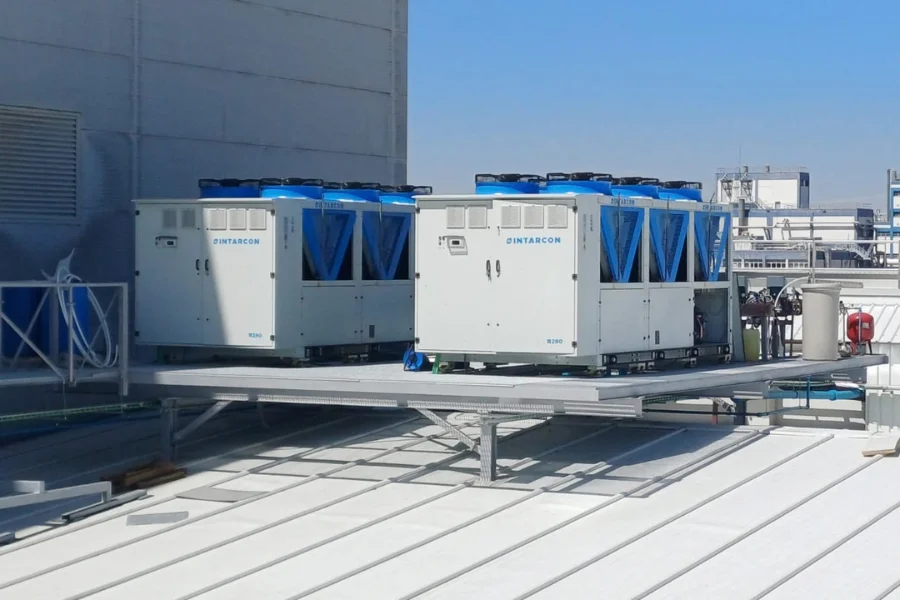
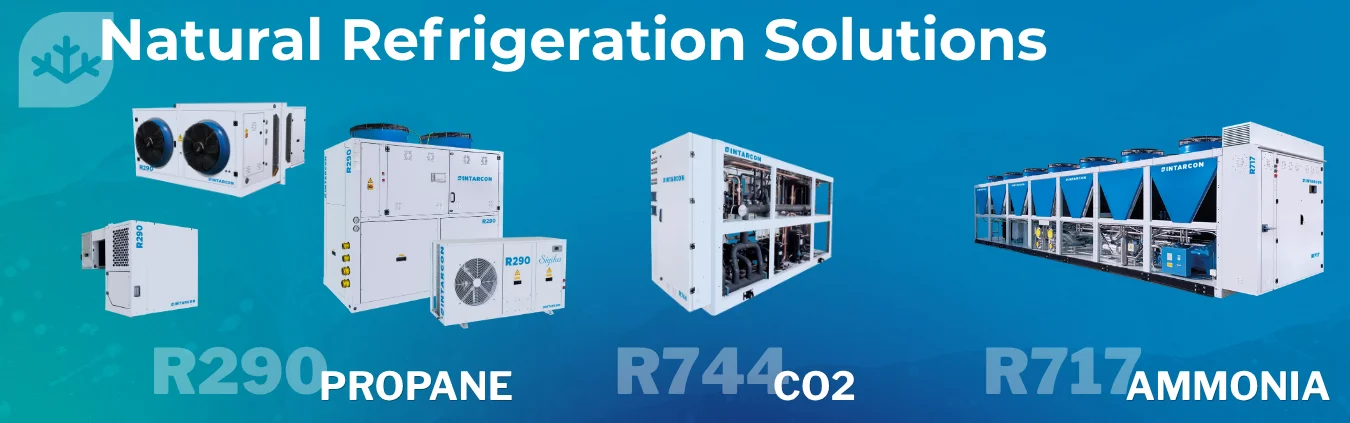
Chiller (intarCHILL) | Propane (R290) | 0.02 | Large cold rooms and warehouses with an indirect glycol circuit. |
R290 Monoblocks Waterloop | R290/Water | Almost zero | Walk-in and medium-sized cold rooms (5 to 200 m³) with an ultra-low charge of confined refrigerant. |
CO₂ Condensing units | CO₂ (R744) | 1 | Negative temperature storage and freezing (−15 °C to −25 °C) in logistics centres. |

Digital Traceability and Real-Time Remote Management
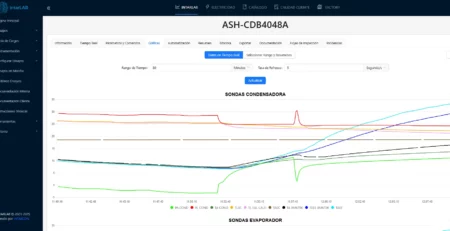
Compliance with quality regulations requires rigorous data control. The integration of cloud-based monitoring and remote management platforms, such as Kiconex, enables:
Continuous historical recording: Secure storage of temperatures and operating parameters, ready for GDP/GMP audits.
Predictive maintenance: Detection of deviations from setpoints and early alarm notifications before the stored product is affected.
Real-time optimisation: Analysis of operating performance to ensure maximum system energy efficiency.
INTARCON Solutions for the Pharmaceutical Industry
At INTARCON, we design and manufacture dedicated refrigeration equipment adapted to each volume and temperature range within the pharmaceutical cold chain:
R290 Compact Systems and intarloop: The ideal solution for walk-in cold rooms (5 to 40 m³) and medium-volume applications (+2 °C to +8 °C / −20 °C), ensuring maximum safety with a minimal natural refrigerant charge.
R290 Water/Glycol Chiller Plants (intarWATT): The ideal alternative for large logistics warehouses (>200 m³) and industrial building temperature control (+15 °C to +25 °C or +2 °C to +8 °C) requiring maximum safety and high thermal inertia.
CO₂ Racks (R744): For large-volume low-temperature storage and freezing applications (−15 °C to −25 °C).
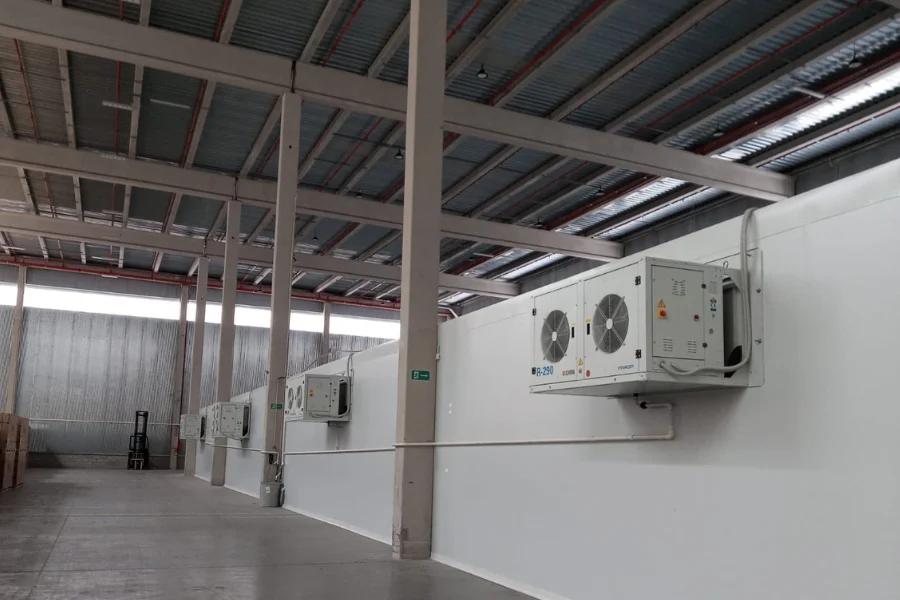
Unit Coolers and Heat Exchangers: Equipped with EC electronic fans, optional anti-corrosion coil treatments and excellent air throw to ensure temperature uniformity and prevent hot/cold spots.
Redundancy Systems and Kiconex Remote Management: Control panels designed for parallel operation, automatic changeover in the event of failure and 24/7 IoT connectivity with cloud-based data logging.