Cybersecurity in refrigeration: protecting the cold chain also means protecting Connectivity
To date, we have no reports of any installations monitored through Kiconex having been affected by the latest cyberattacks.
The security of connected systems is a fundamental concern for the entire industry. For this reason, INTARCON, in collaboration with our technology providers, continues to work on implementing best practices for the protection, updating and maintenance of monitoring solutions.
A cyberattack is no longer necessarily limited to locking a computer, encrypting files or disrupting a website. When digital systems are connected to physical installations, the consequences can directly affect operations.
And commercial refrigeration has just provided a very clear example.
On 2 November 2026, supermarkets and retail establishments across several European countries experienced disruptions to their refrigeration systems. Belgium, Sweden, Ireland, Estonia, Luxembourg, the Netherlands and Finland were among the affected countries. In some establishments, temperatures in cold rooms and refrigerated display cabinets rose abnormally, forcing operators to remove chilled and frozen products.
These incidents occurred barely three weeks after the attacks reported in France on the night of 11–12 October, when hundreds of supermarkets experienced remote interference with their refrigeration systems.
These events raise an increasingly important question for our industry:
How can we continue to benefit from remote monitoring while strengthening the security of our installations?
Digitalisation has transformed the management of refrigeration installations.
Today, we can monitor temperatures, pressures and alarms in real time, analyse historical data, adjust setpoints, anticipate failures and carry out certain maintenance operations without having to visit the site.
These tools offer significant advantages in terms of efficiency, maintenance and service continuity.
However, increasing connectivity also makes it necessary to pay greater attention to cybersecurity.
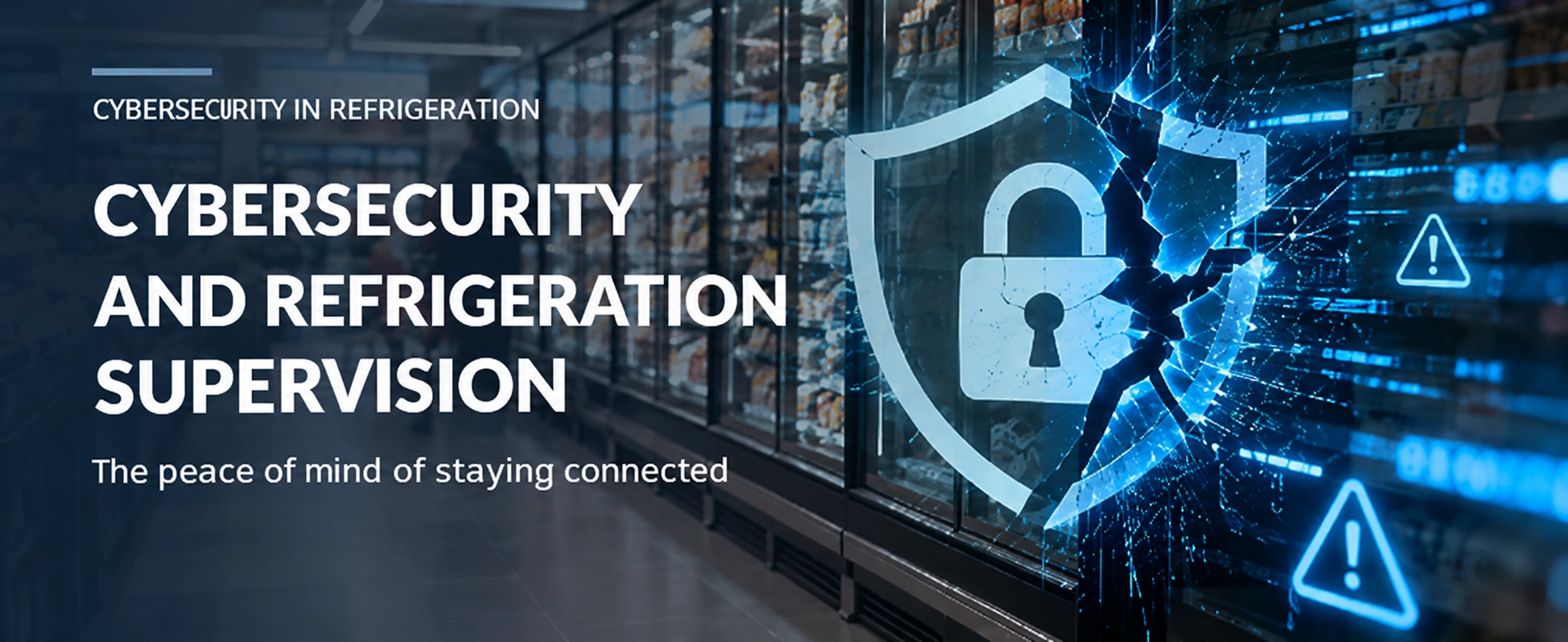
The incidents in France demonstrated how actions targeting a monitoring system can ultimately have physical consequences for the installation and the products stored within it. The French agency CERT-FR warned at the time of multiple compromised systems and recommended paying particular attention to devices with management interfaces directly accessible from the Internet.
Investigations are ongoing, and no single entry method applicable to all incidents has been publicly identified. It would therefore be incorrect to attribute all the attacks to the same vulnerability.
Although investigations are still underway and not all cases necessarily share the same origin, these events provide an opportunity to raise awareness of digital security in the refrigeration industry.
The importance of keeping monitoring systems up to date
In industrial and commercial refrigeration, control and monitoring systems are designed to provide reliability over many years.
At the same time, digital technologies are constantly evolving, along with their security requirements and measures.
For this reason, it is advisable to periodically review the condition of devices, software and firmware versions, as well as the access conditions for monitoring platforms.
This is a common practice in many technological fields and is particularly important when dealing with installations used to preserve food, medicines or other temperature-sensitive products.
Updating and maintaining monitoring systems should be considered an integral part of refrigeration installation maintenance.
This helps to extend their service life, preserve their functionality and reduce potential risks associated with connectivity.
Remote monitoring and cybersecurity must go hand in hand
Giving up remote monitoring would mean losing many of the tools that currently help improve efficiency, maintenance and service continuity.
The question is not whether an installation should be connected, but how that connection is established.
A secure monitoring architecture should minimise the direct exposure of refrigeration controllers to the Internet.
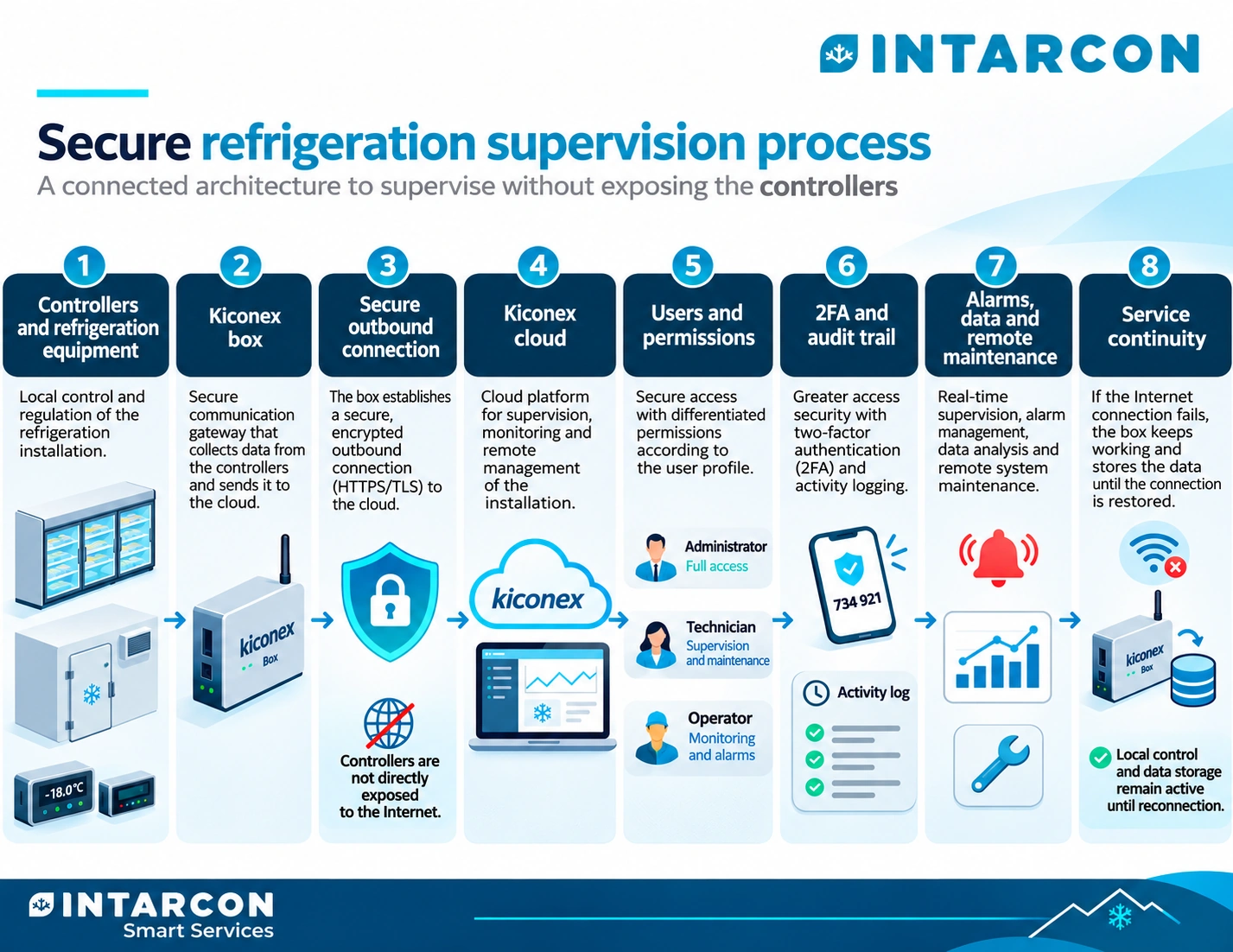
In the architecture used by Kiconex, the Boxes act as communication gateways between the installation controllers and the Cloud platform. Refrigeration equipment exchanges information through local networks and protocols, while the Box itself establishes a secure, encrypted outbound connection to the cloud.
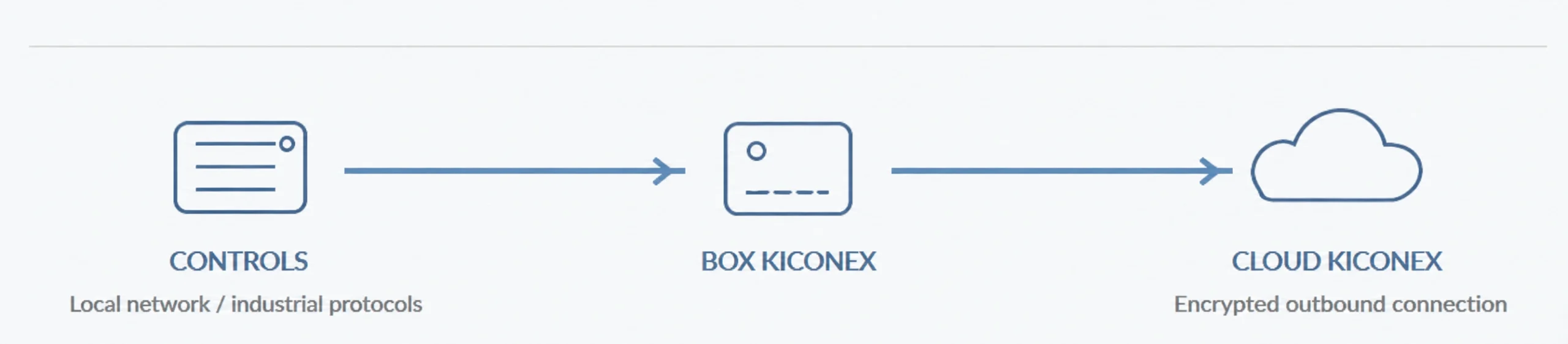
This means that there is no need to open router ports to access refrigeration controllers directly from the Internet.
When using the M2M mobile connectivity offered by Kiconex, an additional layer of protection against external access is provided. Remote maintenance operations are carried out through secure VPN connections.
Not all users should have the same permissions
Cybersecurity does not depend solely on infrastructure.
It also depends on who can access the system and what they can do once logged in.
A monitoring platform should clearly distinguish between viewing information and modifying the operation of the installation.
Kiconex allows individual user accounts to be created and different permission levels to be assigned. For example, a store manager may have read-only access, while changes to setpoints, commands or configuration parameters are restricted to authorised technical personnel.
The platform also supports two-factor authentication (2FA) and maintains a log of actions performed, making it possible to identify who made specific changes and when.
What happens if the Internet connection is lost?
A monitoring architecture should not make the cloud connection a single point of failure.
In the system used by Kiconex, refrigeration control continues to operate independently of the Cloud connection.
If the Internet connection is lost, the controllers continue regulating the installation, while the Box continues storing information and executing locally configured rules. Once communication is restored, the stored data and alarms are transmitted to the platform.
During the disconnection, new real-time alarms cannot be received through that connection, but a loss of connectivity does not, in itself, cause the refrigeration controllers to stop operating.
Cybersecurity does not end when the installation is completed
Designing a secure architecture is just as important as maintaining it throughout its service life.
This involves:
-
Keeping firmware and software up to date.
-
Avoiding management interfaces directly exposed to the Internet.
-
Using VPNs or secure networks for remote maintenance.
-
Replacing devices that have reached the end of their support life.
-
Using strong passwords and two-factor authentication.
-
Defining permissions according to each user’s responsibilities.
-
Keeping records of actions performed on the installation.
-
Having backup and recovery procedures in place.
Kiconex holds ISO 27001 certification for information security management and has procedures in place to review security updates. Its approach also includes replacing certain devices when they become obsolete and can no longer be adequately maintained.
Cybersecurity is now an integral part of refrigeration
Recent events in European supermarkets demonstrate that digital security and cold chain protection can no longer be treated as separate disciplines.
A remote change to a setpoint can ultimately affect a cold room. A cybersecurity vulnerability can lead to product loss. And an obsolete device may continue to operate perfectly while posing a risk that goes unnoticed.
Digitalisation remains an essential tool for developing more efficient, predictive and better-controlled refrigeration installations.
But connecting them requires doing so properly.
Connecting means moving forward. Protecting is our responsibility.
At INTARCON, we remain committed to connected, efficient and secure refrigeration.
Through INTARCON Smart Services, we integrate monitoring and maintenance tools designed to provide a better understanding of how installations operate, anticipate potential deviations and facilitate their ongoing monitoring.
Because monitoring an installation is not just about being able to check its operation from anywhere.
It also means helping to ensure that this connectivity remains secure and reliable.